

Sunscreen for Rosacea: What You Need To Know
Rosacea is hard to hide, for some it’s a persistent red flush across the cheeks and nose, for others, it’s redness and what looks a like a rash that appears out of nowhere triggered by something as unremarkable as a change in temperature, a glass of wine or an unexpected bout of stress. It’s reactive, often unpredictable, and very much tied to lifestyle and environmental factors, which is exactly why sun protection just isn’t optional for those with the skin condition.
What is rosacea?
Rosacea is a chronic inflammatory skin condition that primarily affects the central face, think the cheeks, nose, chin and forehead. It typically shows up as persistent redness, flushing, visible blood vessels and, in some cases, acne-like bumps. “Rosacea mostly affects those withfairer skin,” shares Aesthetic Doctor Dr Anna Hemming.
It tends to develop between the ages of 30 and 50, and while women are diagnosed more frequently, it often appears more severely in men. “There is a genetic tendency, but there’s also a lifestyle link too,” adds Hemming. And current thinking points to a mix of immune system dysregulation, vascular instability and environmental triggers, which is why managing it is rarely as simple as switching moisturiser.
How to identify rosacea
Early-stage rosacea can be hard to detect in so much as it is often mistaken for sensitive skin, mild sunburn or simply ‘flushing easily’. But there are signs to watch out for that will easily confirm that rosacea is the reason your skin looks and behaves the way it does. Those signs include persistent redness across the cheeks, nose, forehead or chin; episodes of flushing that come and go; skin that stings or reacts to products and even water; as well as visible broken capillaries, and in some cases, small inflamed bumps.
Why the sun is such a consistent trigger
Of all the known rosacea triggers, UV exposure sits at the top. According to the National Rosacea Society, 81 per cent of patients identify sun exposure as a primary cause of flare-ups. “Sun protection is a must for everyone at any time of year, but individuals with rosacea may be particularly at risk,” says Dr Zoe Draelos.
UV radiation doesn’t just cause long-term damage, it actively stimulates inflammation and increases blood vessel reactivity in real time. That means that for skin already prone to flushing, UV exposure makes things worse by triggering or worsening redness, visible capillaries and sensitivity. Heat compounds things further, as sun exposure and rising temperatures often coincide, which leads to dilated blood vessels and in turn an intensification of discomfort.
Why sunscreen is non-negotiable for rosacea skin
For rosacea-prone skin, a daily SPF helps managing the condition day to day. Consistent broad-spectrum protection helps reduce flare-up frequency, guards against worsening redness and broken capillaries, supports the skin barrier and limits the low-grade inflammation that accumulates with repeated exposure to UVA and UVB.
But consistency is important. SPF applied once and then forgotten about won’t cut it. Reapplication every two hours during prolonged outdoor exposure is essential.
What to look for in a rosacea-friendly sunscreen
Not all sunscreens are made equal, and for reactive skin the wrong formula can trigger a flare-up before you’ve even left the house. Mineral sunscreens aka those using zinc oxide and titanium dioxide, are generally better tolerated than chemical filters, because they sit on the surface of the skin and reflect UV rays rather than absorb them. This means less biochemical activity in the skin so less chance of irritation.
An SPF of 50 is ideal and formulas that don’t contain fragrance, alcohol and harsh preservatives are ideal, as these are all common irritants for rosacea-prone skin. Texture is worth thinking about too: heavy, occlusive formulas can trap heat and worsen flushing. So, opt for lightweight, breathable options that sit more comfortably on.
Colorescience and rosacea: why the formulas work
Colorescience’s mineral SPF range is particularly well suited to rosacea-prone skin, and the reasons go beyond simply using zinc oxide. The brand’s EnviroScreen Technology provides broad-spectrum defence not just against UVA and UVB, but also against infrared radiation, blue light and pollution. These environmental aggressors are increasingly recognised as inflammation triggers for reactive rosacea prone skin, so formulas with that extra protection are a no-brainer.
Zinc oxide itself has documented anti-inflammatory and soothing properties, making it an active ally for redness-prone skin and crucially, Colorescience has addressed the texture problem that puts many people off mineral SPF, the formulas are refined and wearable enough for daily use.
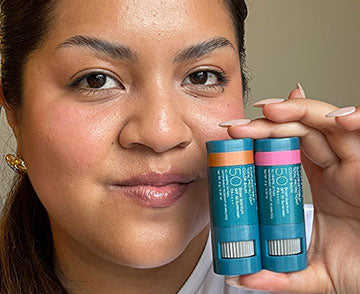
The tinted options, including the Sunforgettable® Total Protection™ Face Shield range go further still. Iron oxides, which provide the tint, offer additional defence against visible light (HEV), a known trigger for both pigmentation and redness in rosacea skin. At the same time, the colour-correcting pigments immediately neutralise redness, meaning the SPF is doing double duty: protecting the skin and evening the complexion in one step.
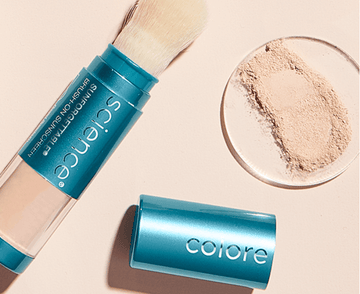
The Brush-On Shield SPF 50, offers a practical solution to the reapplication problem, as its amineral powder that can be applied over makeup throughout the day without disrupting yourbase – hooray!
SPF is a must for rosacea-conscious routines
When it comes to rosacea, it’s rarely one dramatic trigger that causes a flare-up, it’s usuallythe accumulation of small, repeated exposures over time. Because sunscreen helps reduces overall inflammatory load, it’s one of the few tools that can interrupt that cycle of flare-ups before it starts. That’s why SPF isn’t just a holiday staple, but an all year-round must - no matter the weather or the temperature.