

What is physical sunscreen? Here’s everything you need to know
Wrinkles, pigmentation, sagging skin, redness and sunburn are just some of the visible consequences of skipping SPF, yet daily sun protection still doesn’t make it into most people’s daily skincare regime. What’s more, with conflicting advice online over physical and chemical sunscreens and which is best, it’s little wonder that people are confused about SPF’s.
At its core, sunscreen exists for one reason: to protect skin from ultraviolet radiation. UVA rays penetrate the skin deeply, driving collagen breakdown, pigmentation and long-term ageing, while UVB rays affect the surface, causing redness and burns. Both contribute to cumulative skin damage, even on cloudy days, through windows, and during short bursts of exposure.
Understanding how different sunscreens work is the first step to choosing one you’ll actually use consistently.
Physical vs chemical sunscreen: what’s the difference?
There are two main types of sunscreen: chemical and physical. You’ll often see physical sunscreens referred to as mineral sunscreens, and the terms are interchangeable.
Chemical sunscreens work by absorbing UV radiation into the skin, where active ingredients convert it into heat and release it from the body. These formulas are typically lightweight and invisible on application, which has historically made them popular for daily wear and under makeup.
Physical sunscreens, on the other hand, sit on the surface of the skin. They act as a protective shield, reflecting and scattering UVA and UVB rays before they can penetrate.
“Physical sunscreens, are made up of non-toxic ingredients such as zinc oxide and titanium dioxide,” explains Medical Director at Vie Aesthetics, Dr Ioannis Liakas. “Not only are these ingredients not absorbed into the skin, but they have an excellent safety record.”
Unlike chemical formulas, physical sunscreens start working immediately on application and offer broad-spectrum protection without the need for a waiting period.
Why physical sunscreen is often better tolerated
Because physical sunscreens remain on the skin’s surface rather than being absorbed, they are widely considered more suitable for sensitive, reactive and compromised skin types.
“Zinc oxide is an anti-inflammatory and calming agent,” says Dr Liakas. “This means that using mineral sunscreen formulas can actually help soothe conditions such as eczema, rosacea, psoriasis, melasma and acne.”
Physical filters are also less likely to trigger stinging around the eyes or cause post-inflammatory flare-ups, making them a strong option following aesthetic procedures, where inflammation and barrier disruption are already present.
Historically, the downside of physical sunscreen has been cosmetic. Older formulas were thick, heavy and left a visible white cast, particularly on deeper skin tones. But many modern formulations like the Colorescience offering offer advanced pigment technology, and teeny tiny sized actives that have transformed how physical SPF looks and feels. Thinks a smoother texture, no white cast, improved blending and a more even colour pay-off.
Why more experts now favour physical sunscreen
Chemical sunscreens have come under scrutiny in recent years, both for environmental and skin-health reasons. “Oxybenzone in sunscreen has been found to be highly toxic to juvenile corals and marine life,” notes Founder and Medical Director of Thames Skin Clinic, Dr Anna Hemming.
Dr Liakas adds that several chemical filters have been found or are suspected to act as hormone disruptors or allergens. While research continues, the existing data has already shifted professional preference. “Many now opt for mineral sun creams over chemical ones,” he says.
From a skin-health perspective, physical sunscreens also offer greater stability. Because they don’t degrade in the same way chemical filters can under UV exposure, meaning they maintain consistent protection throughout your two-hour wear. Yes, two hours, they still need to be reapplied every 2 hours just like a chemical sunscreen does.
How to apply physical sunscreen
Physical sunscreen should be applied as the final step in your morning skincare routine, before makeup. A teaspoon amount is needed to cover the face, and neck adequately. When it comes to the average body 1 teaspoon per arm, 1 teaspoon on the chest and abdomen, 1 teaspoon on the back and 2 teaspoons per leg are the recommended amounts. But don’t forget the ears, feet, and hands. We recommend half a teaspoon for hands, and the same amount for the feet. For the ears aim to use a quarter of a teaspoon.
Reapply every 2 hours, and if you’re wearing make-up, the Colorescience powder SPFs are particularly useful for topping up protection throughout the day without disturbing your beat.
Choosing the right Colorescience physical sunscreen for your skin
Colorescience offers advanced physical sunscreen formulas that address specific skin concerns while maintaining high-level protection from not just UVA and UVB, but from blue light, pollution and infrared radiation. Here’s how to choose the right one for you…
For oily or acne-prone skin
Colorescience Sunforgettable Total Protection Face Shield Matte SPF 50
Lightweight and oil-absorbing, this formula helps control shine while calming inflammation, making it ideal for breakout-prone or combination skin.
For sensitive or reactive skin
Colorescience Sunforgettable Total Protection Face Shield Classic SPF 50
A gentle, non-irritating option that delivers broad-spectrum protection without triggering redness or discomfort.
For dry or dehydrated skin
Colorescience Sunforgettable Total Protection Face Shield Glow SPF 50
Hydrating with a subtle luminosity, this formula supports skin comfort while enhancing radiance.
For pigmentation and uneven tone
Colorescience Sunforgettable Total Protection Face Shield Flex SPF 50
Available in flexible shade-adapting tones, this SPF offers iron oxide protection, which is essential for defending against visible light that worsens pigmentation.
For ageing concerns
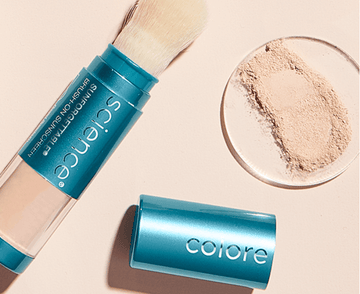
Colorescience Sunforgettable Total Protection Brush-On Shield SPF 50
Ideal for reapplication throughout the day, this antioxidant-rich mineral powder helps protect collagen and elastin without disrupting makeup.
For redness-prone skin
Colorescience All Calm Clinical Redness Corrector SPF 50
Designed to neutralise visible redness while soothing inflamed, sensitive skin, this is particularly helpful for rosacea-prone complexions.
For dark under-eyes
Colorescience Total Eye 3-in-1 Renewal Therapy SPF 35
Protects the delicate eye area while addressing discolouration, fine lines and fatigue.
When it comes to daily skin protection, physical sunscreen offers more than defence. It supports barrier health, calms inflammation and protects skin integrity long-term. And with modern formulas like those from Colorescience, protection no longer comes at the expense of finish, comfort or confidence.