

Should I Apply Sunscreen or Moisturiser First? Revealed
Elements of skincare order gets debated a lot – what type of cleanser should be used first in a double cleansing routine. Should you apply a moisturiser before or after retinol and so on. But when it comes to whether sunscreen comes before or after moisturiser the is only one correct answer and that’s – after. Your moisturiser goes on first and your sunscreen follows.
Read on to discover the order your skincare routine should follow and why.
Cleanse first
It doesn't matter how good your skincare products are if there's a layer of yesterday's SPF, make-up, and dirt sitting between it and your skin. Cleansing isn't glamorous, but it's doing a lot of the leg work in your beauty regime.
The Colorescience Barrier Pro 1-Step Cleanser, removes mineral sunscreen and makeup in one go. Fragrance-free, microbiome-supporting and gentle enough not to leave skin feeling tight or stripped it’s the perfect face wash if you want the rest of your routine to be effective
Serums second
Serums are formulated to penetrate deep within the skin thanks to the smaller molecules of higher concentrations of actives that they are made up of. If you apply them after say a moisturiser or SPF you've essentially blocked them at the door.
Pep Up Collagen Renewal Face & Neck Treatment supports the skin's own collagen production, improving firmness, texture and tone while softening the look of fine lines. It works with the skin's repair mechanisms rather than just sitting on the surface, which is why placement in the routine matters.
Moisturiser third
Moisturisers can do more than simply hydrate the skin. A good one strengthens the skin barrier, supports the microbiome and helps the skin hold its own against environmental stress. Think of it as the buffer between your skin and everything the day throws at it.
Barrier Pro Essential Moisturiser, is clinically tested to do exactly that. It visibly plumps and smooths while reinforcing barrier function, and it creates the kind of even, well-hydrated surface that allows sunscreen to be applied evenly and perform as intended.
Sunscreen last
Sunscreen is arguably the most important step in any morning routine, but sadly it’s still the most skipped despite the fact that UV radiation is one of the primary drivers of premature ageing. Responsible for up to 80 per cent of visible skin ageing which includes fine lines, loss of firmness, uneven skin tone and hyperpigmentation, as well as skin cancer. And it doesn’t require lots of unprotected beach days to see the damage first-hand, as UV rays penetrate clouds, and glass, meaning daily protection matters even in the winter, and even if you barely leave your work desk, home or car.
It’s not only UV that sunscreen protects from, it also protects the skin from pollution, blue light and infrared radiation. All three of which contribute to premature ageing, hyperpigmentation, and skin damage
SPF works by forming a continuous, even film across the surface of the skin. Mineral sunscreens made from zinc oxide or titanium dioxide, sit on top of the skin and physically deflect UV rays rather than absorbing them. For that film to function properly, it needs to be the outermost layer of your skincare. Put anything on top of it and that continuous barrier is broken up, leaving gaps in coverage and reducing the overall protection factor you’re actually getting.
This is why sunscreen has to go on after moisturiser, not before. If moisturiser goes on over SPF, it physically disrupts the protective film, making it less effective. And because moisturiser needs to absorb into the skin to do its job, layering it over sunscreen prevents that too, so both products underperform. Applied in the right order, each one can do what it’s designed to do.
One more thing worth knowing: sunscreen should go on before make-up, not after - with one exception. A mineral powder SPF, can be applied over make-up as a top-up, making it a practical option for reapplication without disturbing your base.
Which SPF to use
Sunforgettable Total Protection Face Shield Classic SPF 50
A tinted formula that works across most skin tones that leaves a dewy, skin-like finish. Powered by EnviroScreen Technology it offers broad-spectrum protection against UV and environmental aggressors, with hydration built in. This is the perfect SPF to reach for if you want coverage and protection in a single step.
Sunforgettable Total Protection Face Shield Matte SPF 50
Made for oily and blemish-prone skin, this oil-absorbing, pore-blurring SPF offers a matte finish that doesn't feel heavy or make the skin look dull. This is the best option for combination to oily skin that find dewy finishes leave their skin too shiny.
Sunforgettable Total Protection Brush-On Shield SPF 50
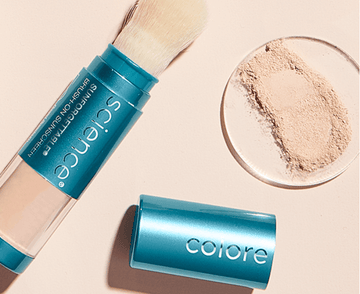
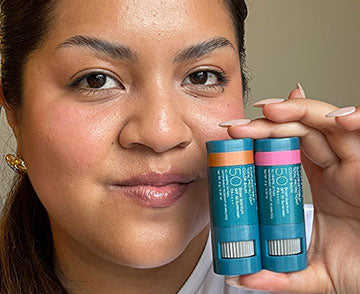
This is an innovative mineral powder sunscreen for reapplication during the day. It works wonders at setting make-up, controlling shine and maintaining UV, pollution and blue light protection on the go.